
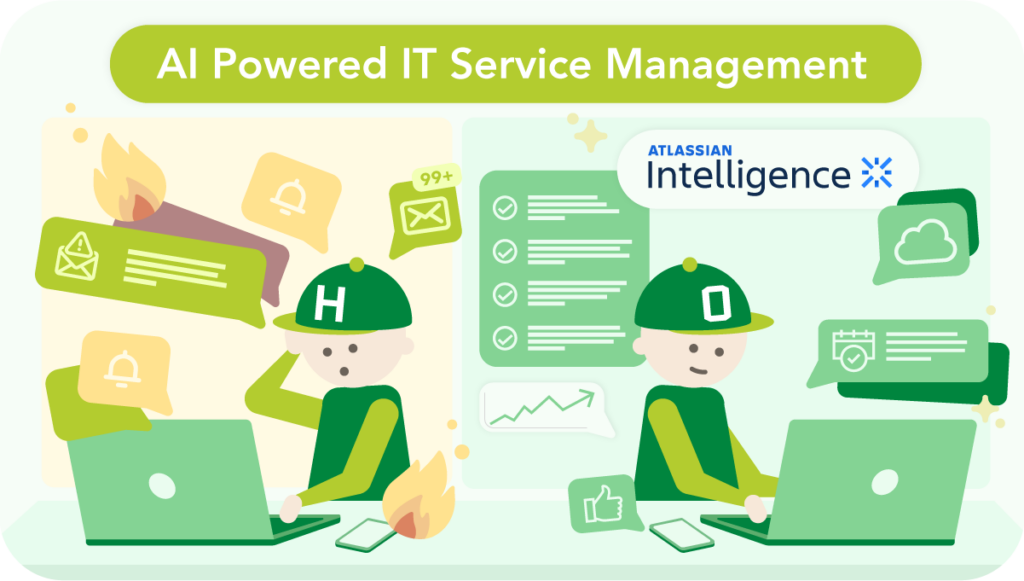
- Relief in day-to-day operations: Recurring tasks are reduced, tickets arrive in a more structured way, and can be processed more quickly.
- Better overview instead of gut feeling: Summaries and consistent ticket data create transparency around priorities, bottlenecks, and workload.
- More structure without new tools: The AI works directly in Jira Service Management, without additional systems or complex parallel processes.
- Knowledge remains usable: Confluence content is embedded in the right context, instead of disappearing into individual minds or outdated pages.
- Scales with growth instead of constant rebuilds: Service desk structures can be evolved without having to rebuild everything from scratch each time.
In many organizations, the service desk is both the heart of IT operations and a permanent construction site. When it runs smoothly, hardly anyone notices. When it falters, everyone feels it immediately. Tickets come in from all directions, information is missing or incomplete, priorities are set incorrectly, and in the end, a surprising amount depends on individual people who “know how things really work.” This is exactly where AI-powered IT Service Management comes in – soberly considered and without much fanfare. Not as a futuristic promise of salvation, but as pragmatic support for everyday work.
Atlassian Intelligence brings artificial intelligence directly into Jira Service Management, right where processes, tickets, and communication already take place. The goal is not fireworks, but a service desk that simply works – even when things get stressful.
Where traditional service desks reach their limits
Many service desks have grown historically. Categories were introduced at some point, SLAs were added later, and automations were implemented selectively. The result is usually a system that basically works – but only as long as experienced employees are constantly stepping in to correct things.
Typical symptoms include:
- incomplete or unclear ticket descriptions
- incorrect prioritization by end users
- manual assignment to teams or individuals
- recurring follow-up questions, even though the information is actually available
These are issues that could point to misconfiguration, for example because users were not sufficiently trained. Just as well, they may indicate structural and process-related problems. In both scenarios, AI can provide meaningful support at this point – provided it is used correctly.
What Atlassian Intelligence actually delivers
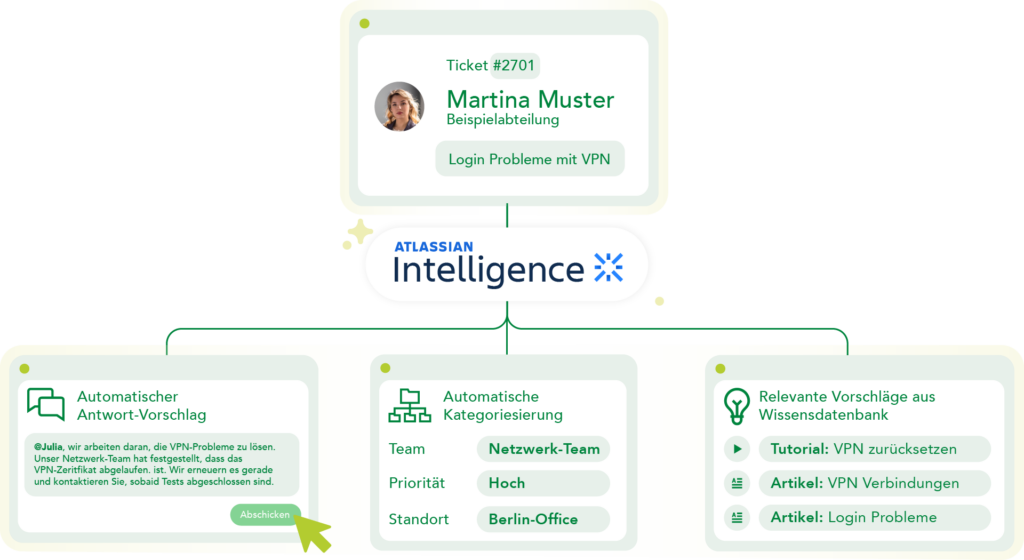
Atlassian Intelligence is deeply integrated into Jira Service Management and works with existing data, workflows, and knowledge articles. Instead of introducing yet another system, the existing tool is simply made smarter.
An important point here: In the background, AI functions may work with external models such as ChatGPT, unless this is deliberately restricted. Especially when dealing with sensitive information – such as personal data – clean configuration and a clear understanding of data flows are essential.
A few everyday examples that most people will recognize in one form or another:
- Intelligent ticket summaries
Especially in longer cases with many comments, it is easy to lose track. Atlassian Intelligence automatically summarizes tickets, including current status, open points, and relevant decisions. This saves time during handovers, escalations, or simply when picking up a topic again. - Support for replies and comments
Based on existing information, the AI generates suggestions for replies or comments. Consistent, factual, and context-aware. Particularly helpful for standard follow-ups or status updates that would otherwise require a lot of manual typing. - Structure instead of free text
Phrases like “Doesn’t work” or “Urgent!!!” are everyday reality in service desks. Atlassian Intelligence helps structure content, highlight relevant information, and make tickets more usable – without forcing users into complex forms. - Using knowledge at the right moment
Existing Confluence articles or internal solution descriptions can be suggested in a targeted way. Not as a rigid FAQ list, but tailored to the specific ticket and its context.
Quick side note: Atlassian Intelligence is not the same as Rovo. Atlassian Intelligence refers to the AI features within Atlassian products, while Rovo is designed as a standalone, AI-powered search and work interface. The two complement each other, but they are not identical.
Automation that feels like everyday work
The biggest advantage of Atlassian Intelligence is that it does not replace existing automations, but enhances them. Clean workflows remain the foundation – AI makes them more effective.
A typical day-to-day scenario: A ticket comes in via the portal. The AI helps structure the content, generate a short summary, and highlight relevant terms. Existing Jira automations then take over: assignment to the appropriate team, setting the priority, starting the SLA. No media disruption, no additional tool.
The result is a service desk that responds more consistently, regardless of who is currently on duty.
User story: Less chaos, more focus
As an IT employee
I want incoming tickets to be automatically prepared in a clear and understandable way
so that I spend less time on follow-up questions and can focus on the actual solution.
Before Atlassian Intelligence, a ticket often meant: read, interpret, ask questions, categorize. Today, the system provides me with a summary, I immediately see what it’s about, and I can get started right away. That saves time – and above all, nerves on already busy days.
When the use really pays off
Atlassian Intelligence delivers the greatest benefit where:
- many tickets come in with similar patterns
- multiple teams collaborate at the service desk
- knowledge exists but is not used consistently
- reliability and consistency are more important than individual “heroics”
Conclusion: Create structure before things get complicated
AI-powered ITSM does not create value through automation for automation’s sake. Atlassian Intelligence is not a self-runner, but an amplifier for clean processes and clear structures.
This is exactly where we come in: We help design service desk processes in a sensible way, build automations pragmatically, and integrate Atlassian Intelligence so that it truly provides relief in everyday work. Not in theory, but aligned with real-world workflows.
The result is not a showcase, but a service desk that thinks along, grows with you – and above all, works reliably.