Definition of Change Management
In change management, tasks, activities, and measures are defined that bring about cross-departmental and substantive change within an organization.
Change Management Consulting
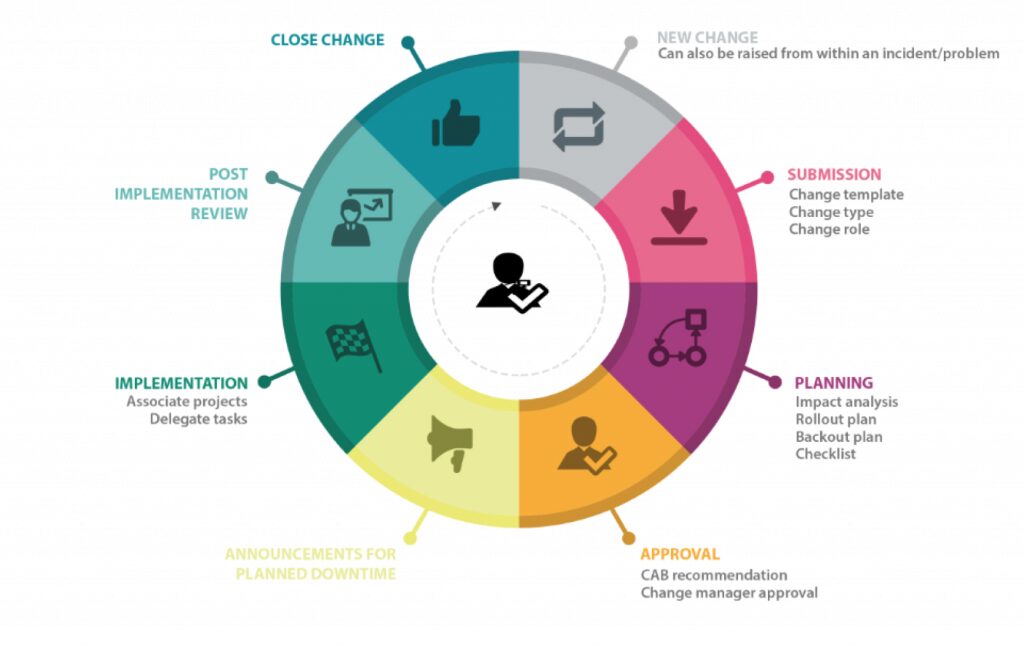
Change management is applied, for example, when implementing new strategies or transitioning to new systems or processes. In our change management consulting, we support our customers from the initial idea through to the continuous further development of a solution. We coordinate very closely with those responsible for the project and, together, ensure that the changes are as smooth and minimally disruptive as possible for everyone involved.
Organizational Change Management
Organizational change management refers to changes that affect workflows or other areas of the company. Here, it is usually essential to accompany organizational change with method and structure in order to reduce the impact on those affected and involved.


Technical Change Management
In consulting, we use the term technical change management primarily to describe changes within or originating from the IT domain that adapt systems, applications, or processes. In addition to this, there are generally three distinct processes:
- Normal Changes
- Standard Changes
- Emergency Changes
Across all processes, the focus is on implementing changes with as little disruption as possible. In particular, it is important not only to provide precise descriptions of what is to be done and by whom, but also to define a so-called backout plan or rollback procedure. These procedures are intended to enable a rapid return to the previous (operational) state in the event of critical incidents. As a subprocess of change management, technical change management has already been implemented in many companies, as compliance requirements such as ISO 27001 or the GDPR have been adopted.
Overview of Change Types
Normal Changes
Normal changes, also known as regular changes, describe changes that must be assessed individually due to their risk and potential impact, as they have a relevant risk profile. In addition, these changes may be characterized by their uniqueness—meaning they have not previously been carried out in the intended manner. Normal changes usually require approval by the Change Advisory Board.

Standard Changes
Standard changes describe changes that, by their nature, have a low risk profile. As a rule, standard changes are activities that are performed regularly and whose effects are known. Standard changes are typically approved once by the Change Advisory Board and are thereafter exempt from further approval.
Emergency Changes
Emergency changes describe changes that are often intended to prevent a concrete harm. Depending on the situation, this harm may arise from various areas:
- Reputation
- Financial damage
- Danger to life and limb
- Prevention of other threatening situations
Emergency changes are often implemented outside of business hours and, due to their urgency, usually involve subsequent approval processes. Frequently, an Emergency Change Advisory Board agreed upon in advance through deployment planning is convened to decide on the situation and the appropriate measures.
Change Management Consulting and ITIL
In the ITIL world, change management is defined as a core process of Service Transition. This process ensures the efficient and low-risk adaptation of the IT infrastructure for the operation of existing business services. To this end, ITIL change management uses project management methods such as PRINCE2 or PMI to guide complex and high-risk changes through the organization as smoothly as possible. Particularly with regard to the impacts of organizational change management, ITIL seeks to influence critical success factors in advance through stakeholder analyses and stakeholder management.
What does Honicon offer you?
Honicon supports you with change management consulting during implementation or in the execution of existing processes. In addition to the “technical” implementation, this primarily includes detailed project planning as well as the provision of the process landscape, for example using software solutions from the vendor Atlassian. Our expertise also lies in methodological consulting on precautions relating to backout or rollback plans for technical change management, as well as stakeholder analysis for organizational change management.
In the free initial consultation, we show you which process-oriented solutions we can combine with tools and methods for you, so that your change management not only meets compliance requirements but also delivers real added value for your organization.
Schedule your
free initial consulting